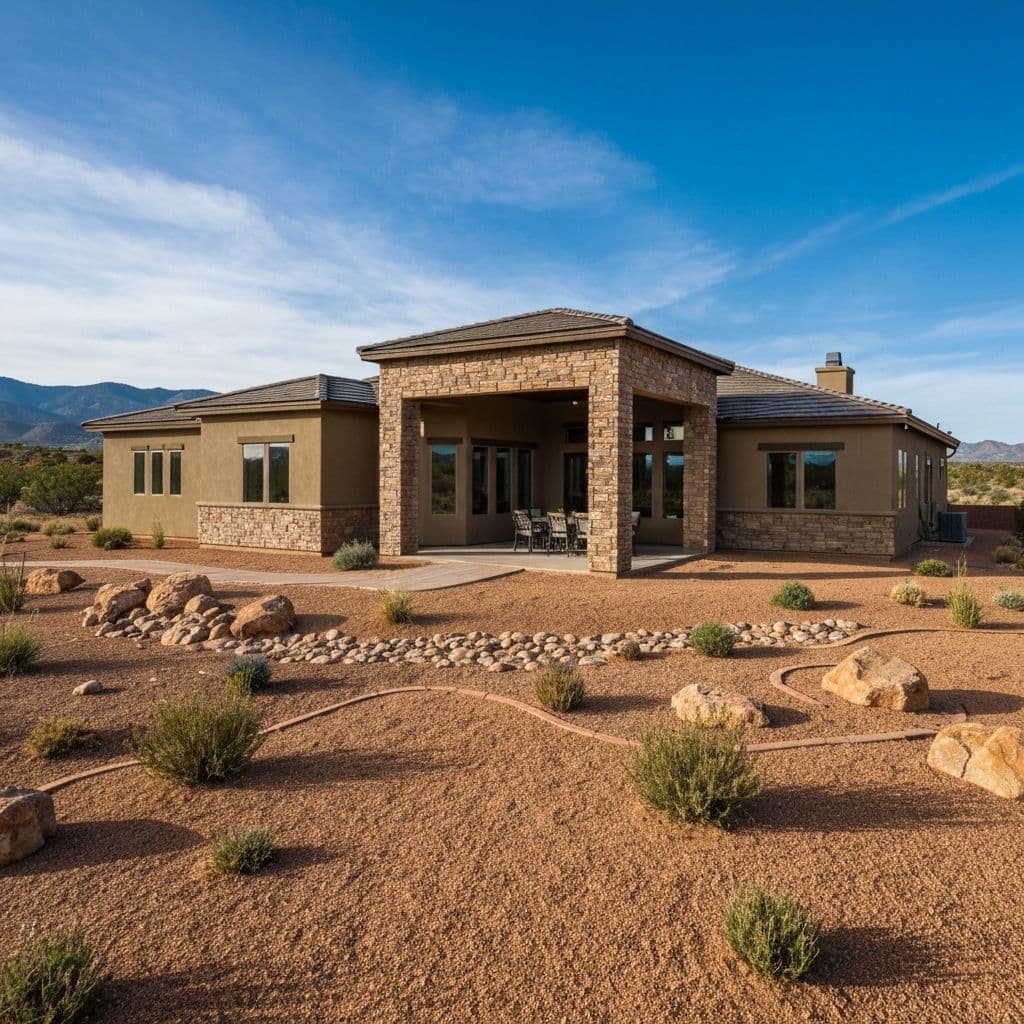


Prescott Cost of Living Overview
Prescott's overall cost of living runs roughly 5% above the national average per the Bureau of Labor Statistics Consumer Expenditure Survey for the Western region. Median home price sits at approximately $581,000 in Prescott proper and $441,000 in Prescott Valley per Redfin. A typical two-person household budgets roughly $3,500 to $5,500/month all-in (housing, utilities, groceries, healthcare, transportation). That's about 25 to 35% lower than coastal California and 8 to 12% higher than Phoenix metro, housing drives nearly all of the gap.
The reason Prescott lands slightly above average is almost entirely driven by housing. Strip out housing and the picture changes dramatically, groceries, utilities, healthcare, and transportation all come in at or below national norms. For anyone relocating from a coastal metro like Los Angeles, San Francisco, Seattle, or Portland, the net effect is a significant reduction in monthly expenses. I have helped hundreds of families make this move, and the consistent feedback is that their dollar stretches further here than they expected.
Prescott is not the cheapest town in Arizona, that distinction goes to places like Casa Grande or Coolidge. But it offers something those towns do not: a genuine four-season mountain lifestyle at 5,300 feet, a historic downtown, and a community that consistently ranks among the best small cities in the West. The cost of living here reflects that quality of life, and for most relocators it represents outstanding value.
Let me walk through every major expense category so you can build a realistic budget before you make the move.
Housing Costs
Housing is the single largest line item in any cost-of-living analysis, and it is where Prescott shows the most interesting dynamics. The market here has appreciated steadily over the past several years, but it remains dramatically more affordable than coastal alternatives. If you want to see what's currently available at each price point, you can explore new home communities across Prescott and Prescott Valley directly.
The median home price in the Prescott metro area is approximately $581,000 as of early 2026, according to Redfin market data and the Prescott Area Association of Realtors. That is a real number, not a starter home, not a fixer-upper, but the actual midpoint of what is selling. Compare that to Phoenix at roughly $430,000 (lower, but with a very different lifestyle), Scottsdale at $750,000 or higher, and coastal cities where the median exceeds $900,000.
New construction is where the value story gets compelling. ECCO Homes builds energy-efficient homes in Prescott Valley starting from the high $400s. These are not stripped-down spec homes, they include modern floor plans, energy-efficient systems, and quality finishes. Capstone Homes offers premium construction starting from $805,900 in Prescott Valley and from $949,900 in Prescott proper. Both builders deliver homes that would cost 30% to 50% more in a comparable market.
For buyers coming from California, Oregon, or Washington with home equity, the math is straightforward. Sell a $1.2 million home in the Bay Area, buy a brand-new construction home in Prescott for $600,000 to $800,000, and pocket the difference, or invest it and live on the income. I see this pattern every month.
Rental costs in Prescott have increased along with the broader market. A one-bedroom apartment runs approximately $1,100 to $1,400 per month, while a three-bedroom house rents for $1,800 to $2,500 depending on location and condition, based on current Zillow and Apartments.com listings. These are higher than the national median but lower than most Western metros. Rental inventory is tighter than in larger cities, so if you plan to rent while you search for a home, I recommend securing a lease before you arrive.
Property taxes in Yavapai County are remarkably low. The all-in effective property tax rate (county + school district + special districts) averages approximately 0.45% of market value, according to the Yavapai County Assessor FY 2026 combined rate of 1.9388 per $100 assessed value applied to Arizona's 10% residential assessment ratio. On a $581,000 home, that works out to roughly $2,600 per year, or about $217 per month. Compare that to states like Texas (1.8% effective rate), New Jersey (2.2%), or Illinois (2.1%), and the savings are substantial. Arizona's property tax system also caps annual increases on existing properties, which provides predictability for long-term budgeting.
Taxes in Prescott
Arizona's tax structure is one of the most compelling reasons people relocate here, particularly retirees and remote workers with flexibility in where they establish residency.
Arizona has a flat income tax rate of 2.5%, according to the Arizona Department of Revenue. This is one of the lowest state income tax rates in the country. To put it in perspective, California's top marginal rate is 13.3% (per the California Franchise Tax Board), Oregon's top rate is 9.9% (per the Oregon Department of Revenue), and Colorado's flat rate is 4.4% (per the Colorado Department of Revenue). For a household earning $150,000, moving from California to Arizona saves approximately $10,000 to $12,000 per year in state income tax alone.
Arizona does not tax Social Security benefits. This is a major consideration for retirees, roughly a dozen states still tax Social Security to some degree, including Colorado (with limited deductions), Montana, and Connecticut. In Arizona, your Social Security income is completely exempt from state taxation, according to the Arizona Department of Revenue retirement income guidelines.
Arizona has no estate tax and no inheritance tax. This matters for families doing long-term wealth planning. States like Oregon (with an exemption of only $1 million) and Washington (with a top estate tax rate of 20%) impose significant taxes on estates. Arizona imposes none.
Sales tax in Prescott totals approximately 9.3% (as of 2026) when you combine Arizona's state rate (5.6%), Yavapai County's rate, and the City of Prescott's transaction privilege tax. This is moderate by national standards, lower than most California cities (7.25% to 10.25%) but higher than Oregon (which has no sales tax). Groceries are taxed in Arizona, which is worth noting for budget planning.
The overall tax picture for a typical relocating household, especially one coming from a high-tax state, represents thousands of dollars in annual savings. I frequently work with clients who discover their tax savings alone cover a significant portion of their mortgage payment. For the step-by-step playbook on timing the move, see my full relocation guide.
Utilities
Prescott's elevation of 5,300 feet gives it a climate advantage that directly affects utility costs. You will not face the brutal summer cooling bills common in Phoenix, and you will not face the heavy winter heating bills of mountain towns at higher elevations like Flagstaff.
Based on data from Arizona Public Service (APS), the primary electric provider, and self-reported data aggregated by Numbeo and the Energy Information Administration, typical monthly utility costs in Prescott break down as follows. Electricity runs $120 to $180 per month averaged across the year, with summer months (June through September) at the higher end when air conditioning runs and winter months lower. Natural gas for heating averages $40 to $70 per month, with December through February at the higher end. Water and sewer combined run approximately $60 to $90 per month through the City of Prescott utilities. Internet service from providers like Suddenlink or TDS ranges from $60 to $90 per month for reliable high-speed service.
All in, expect $280 to $430 per month for a typical three-bedroom home, depending on the season and your usage patterns. This is meaningfully lower than Phoenix in summer, where electric bills routinely hit $300 to $400 per month from June through September, according to APS rate data, and lower than northern climates where winter heating dominates. The four-season climate at 5,300 feet is genuinely the sweet spot for utility costs.
If you choose a new construction home from a builder like ECCO or Capstone, expect utility costs at the lower end of these ranges. Modern insulation, ENERGY STAR windows, efficient HVAC systems, and smart thermostats make a measurable difference.
Groceries and Food
Grocery costs in Prescott are approximately 3% to 5% above the national average, according to the Council for Community and Economic Research (C2ER) cost-of-living index data. In practical terms, a household spending $800 per month on groceries nationally would spend roughly $825 to $840 in Prescott. The difference is marginal and largely driven by transportation costs to a smaller market.
Prescott has solid grocery options. Safeway and Fry's (Kroger) are the primary full-service stores with multiple locations. Sprouts Farmers Market offers natural and organic options at competitive prices. Trader Joe's is present for those who prefer their curated selection. Walmart Supercenter and Costco in Prescott Valley provide bulk buying and budget options. There is also a strong local scene, the Prescott Farmers Market operates seasonally and offers local produce, meats, and specialty items.
Dining out in Prescott covers a wide range. Casual dining averages $12 to $20 per entree, while Prescott's growing upscale restaurant scene on Whiskey Row and the downtown square runs $25 to $45 per entree. The restaurant scene has improved significantly in recent years and continues to expand.
For budget purposes, a household of two adults should plan $700 to $1,000 per month for groceries and $200 to $500 for dining out, depending on preferences. A family of four should budget $1,000 to $1,400 for groceries.
Healthcare Costs
Access to quality healthcare is a top concern for relocators, especially retirees. Prescott delivers well in this category.
Yavapai Regional Medical Center (YRMC) operates two campuses, the main West campus in Prescott and the East campus in Prescott Valley. Together they provide comprehensive services including emergency care, surgical services, cardiac care, oncology, and orthopedics. YRMC is a community-based, not-for-profit hospital system that has served the region since 1943, according to the Yavapai Regional Medical Center Foundation.
The Northern Arizona VA Health Care System operates a facility in Prescott that serves veterans across the region. This is a significant asset for the large veteran community in the Prescott area.
For specialists not available locally, Flagstaff Medical Center is about 90 minutes north, and the full range of Phoenix metro hospitals, including Mayo Clinic, Banner Health, and HonorHealth, are roughly 90 minutes to two hours south.
Healthcare costs in the Prescott area track close to the Arizona average, which is approximately 5% below the national average according to the Kaiser Family Foundation state health spending data. Medicare Advantage plans are widely available with competitive premiums. If you are on employer-sponsored insurance or purchasing through the ACA marketplace, expect premiums comparable to other mid-sized Arizona markets.
A couple aged 65 or older on Medicare should budget approximately $400 to $700 per month combined for Medicare premiums, supplemental insurance, and out-of-pocket costs. This is consistent with national Medicare cost estimates published by the Centers for Medicare and Medicaid Services (CMS).
Transportation
Prescott is a car-dependent community. There is no public transit system to speak of, no bus routes, no light rail, no commuter rail. A reliable vehicle is essential. If you are coming from a walkable city, this is an adjustment, but it is consistent with virtually all mid-sized Western towns.
The upside is that Prescott's traffic is minimal. Your daily commute within town rarely exceeds 15 minutes. There is no rush hour gridlock, no freeway crawl, and parking is free almost everywhere including downtown.
Gas prices in Prescott typically run $0.10 to $0.20 per gallon above the Phoenix average, which itself tracks near the national average according to AAA's fuel gauge report. As of early 2026, expect to pay approximately $3.20 to $3.50 per gallon for regular unleaded.
The key distances to know are Prescott to Phoenix (roughly 100 miles, about 1 hour 45 minutes via Highway 69 and I-17), Prescott to Phoenix Sky Harbor Airport (the same drive, plan two hours with airport logistics), and Prescott to Flagstaff (approximately 90 minutes north on Highway 89A through scenic Mingus Mountain or via I-17).
Auto insurance rates in Arizona are moderate. The average annual premium is approximately $1,600 to $2,000 according to the National Association of Insurance Commissioners (NAIC), which is below the national average of approximately $2,150. Prescott's low traffic volume and low crime rate contribute to favorable rates.
For budget purposes, plan $400 to $600 per month for total transportation costs, including a car payment or depreciation, insurance, gas, and maintenance. If your cars are paid off, that drops to $200 to $350 per month.
Monthly Budget Examples
Here is what realistic monthly budgets look like at three levels for a two-person household in Prescott. These assume you own your home.
Modest Budget, approximately $3,500/mo: Housing (mortgage/taxes/ins) ..... $1,800 Utilities ........................ $300 Groceries ........................ $700 Healthcare ....................... $350 Transportation ................... $250 Personal/Entertainment ........... $100
Comfortable Budget, approximately $5,500/mo: Housing (mortgage/taxes/ins) ..... $2,800 Utilities ........................ $375 Groceries/Dining ................. $1,000 Healthcare ....................... $500 Transportation ................... $350 Personal/Entertainment ........... $475
Luxury Budget, approximately $8,000+/mo: Housing (mortgage/taxes/ins) ..... $4,000 Utilities ........................ $425 Groceries/Dining ................. $1,400 Healthcare ....................... $600 Transportation ................... $500 Personal/Entertainment ........... $1,075+
These are realistic ranges based on actual client experiences and current Prescott-area costs. Your personal budget will vary based on housing choice, lifestyle preferences, and whether you carry a mortgage.
Prescott vs Other Arizona Cities
Choosing where to land in Arizona is a real decision. Here is how Prescott stacks up against the other cities my clients typically consider.
Prescott, median home price approximately $581K. Elevation 5,300 feet with four true seasons. Summer highs near 89 degrees, winter highs near 50 degrees. Yavapai County effective property tax rate approximately 0.45% (per Yavapai County Assessor, FY 2026). A historic downtown, 277 sunny days, and a strong community feel. Best for buyers who want mild weather, small-town character, and outdoor access without desert heat.
Phoenix Metro, median home price approximately $430K (varies widely by suburb). Elevation 1,100 feet. Summer highs regularly exceed 110 degrees from June through September. Maricopa County property tax rate approximately 0.6%. Full big-city amenities, international airport, professional sports, extensive dining and shopping. Best for buyers who want urban convenience, do not mind extreme summer heat, and want the lowest housing costs in a major metro.
Tucson, median home price approximately $350K. Elevation 2,400 feet. Slightly cooler summers than Phoenix but still hot. Pima County property tax rate approximately 1.0%. University of Arizona brings cultural amenities, growing food and arts scene. Best for budget-conscious buyers who want a mid-sized city feel with more character than Phoenix suburbs.
Flagstaff, median home price approximately $625K. Elevation 7,000 feet. Cool summers, cold winters with significant snowfall (over 100 inches annually, according to NOAA). Coconino County property tax rate approximately 0.9%. A true mountain town with Northern Arizona University, skiing at Snowbowl, and proximity to the Grand Canyon. Best for buyers who love winter sports and do not mind heavy snow. Notably more expensive than Prescott with a smaller economy.
Sedona, median home price approximately $900K or higher. Elevation 4,350 feet. Stunning red rock scenery, very strong tourism economy. Yavapai/Coconino County border with property tax rates around 0.6% to 0.8%. Extremely limited inventory drives prices well above comparable homes in nearby communities. Best for buyers with larger budgets who want iconic scenery and accept the tourist traffic and limited services.
For most of my clients, especially those relocating from out of state who want a balance of climate, community, affordability, and lifestyle, Prescott consistently comes out on top. It offers the four-season climate of Flagstaff without the heavy snow, the small-town feel of Sedona without the million-dollar entry point, and a quality of life that Phoenix simply cannot match despite its lower housing costs.
The Bottom Line
Prescott's cost of living is not the cheapest in Arizona, and it is not the cheapest in the country. But for the lifestyle it delivers, four seasons at 5,300 feet, a vibrant historic downtown, 277 sunny days, and a welcoming community, it represents exceptional value. Especially for anyone leaving a high-cost coastal market.
The combination of low state income taxes (2.5% flat), no Social Security tax, no estate tax, reasonable property taxes, and moderate utility costs creates real monthly savings. Most households relocating from California, Oregon, or Washington see $1,500 to $3,000 in monthly savings even after accounting for new homes Prescott AZ buyers typically target.
If you're weighing the construction timeline and contract side of the move, start with the new homes buyer's guide for a walk-through of the 9-step process.
I work with relocators every day who are making this exact calculation. If you want to see how your specific budget maps to Prescott, reach out. I will run the numbers with you and show you exactly what your money buys here.